
Living Room (EE)




Log Fire
Fire safety
Fire safety
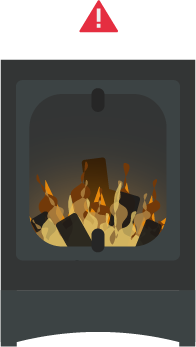
In many homes, log burners and open fires are used as a source of heating. There are a number of steps you can take to ensure that you are using a log burner or open fire safely.
Maintenance
- Regularly maintain and service your stove (e.g. annually, or as the stove manufacturer advises).
- Get your chimney swept regularly. How often you should sweep your chimney depends on the type of fuel you use. Lincolnshire Fire and Rescue recommendations are: smokeless fuels once a year; coal twice a year; wood four times a year; oil once a year; gas once a year. The risk of having a chimney fire reduces when chimneys are swept regularly. It also reduces the risk of a build-up of carbon monoxide.
- Consider how often and for how long you use this type of heating, especially if you have other ways of heating your home. If you have an older or inefficient stove, consider replacing it with a modern efficient model.
- Go into your loft/roof space occasionally to check the chimney when the fire is alight. Check for smoke or soot coming from cracks, defective brickwork or mortar joints. Defects in your chimney could cause a fire. Only enter the loft if it is safe to do so and you are physically able to.
Use
- Use only the manufacturer’s recommended fuels.
- Do not light fires using flammable liquids such as petrol or paraffin.
- Do not burn paper or rubbish on fires in the grate.
- Do not overload the fire with fuel.
- Use a thermometer, moisture meter and stove fan to help improve efficiency, save money and reduce pollution.
- Ventilation in the room is important, to reduce the risk of carbon monoxide build up, and to help the fire burn more efficiently.
- Keep the wood burner door closed as much as possible. When the fire is lit, shutting the door helps contain sparks. Air in your home can be polluted when the door is opened to refuel the stove, and when clearing up the ash: minimise the time your stove door is open, and ventilate your room when clearing up ash.
- Use fire guards: these will stop embers and sparks from reaching flammable materials such as carpets and furnishings. They can also act as a barrier to children or pets, who may be at risk of burning themselves on fires or log burners. Some fire guards are moveable; others can enclose the whole fireplace and be fixed to the wall.
Fire safety
- Store and stack your logs so they are well ventilated.
- Store fuels (wood, coal) safely away from the fire.
- Keep flammable materials (furniture, curtains etc.) well away from fires and log burners.
- Never leave fires unattended.
- Fit a carbon monoxide alarm and fire alarm. There is always a risk of fire using this type of heating, and fires, stoves and log burners can produce carbon monoxide. Install detectors so that you are alerted to any issues.
- Ensure that the fire is fully out before going to bed or leaving the fire.
- When disposing of ashes from fires and log burners, wait until the ashes are completely cold, and use a metal, non-combustible ash can to remove the ashes. Store ashes outside the home, well away from the building, and stand them on a non-combustible surface. Consider dousing the ashes with water to ensure they are fully out.
In some areas of the UK there are restrictions on the kinds of fuel that can be burned on open fires and in log burners. The DEFRA map Smoke Control Area Interactive Map can give an idea of the areas of the UK which are Smoke Control Areas. The data from this map is indicative only and you should always contact your local council to find out if you live in a Smoke Control Area.
Risk
Risk
Using log burners and open fires incorrectly can pose a significant fire risk, which can result in injury and death.
Using log burners and open fires can affect air quality: when materials burn they can emit small particles into the air, which can worsen respiratory conditions such as asthma. There is also the risk of carbon monoxide emissions and build up. Carbon monoxide is a colourless, odourless gas which can cause symptoms such as headaches, weakness, dizziness, nausea or vomiting and sleepiness. In very severe cases, carbon monoxide poisoning can cause death.
Cost
Cost
Free Good fire safety awareness and behaviours (see information above).
£ Smoke and carbon monoxide detectors are relatively cheap to buy, as are fire guards. Make sure that detectors are fitted in appropriate places in your home. Smoke alarms should be fitted to the ceiling, and there should be at least one alarm on each storey of your home. They should be fitted at least 30cm away from walls or light fittings, and away from heaters or air conditioners (as these can stop alarms working properly). An ideal position is in the middle of a room, with additional alarms on hallways and landings. The alarms need to be fitted somewhere you can easily hear them, especially if you are asleep. Make sure that any alarms you get conform to British Standards (look for the kite mark) and follow the manufacturers’ instructions when fitting them. Carbon monoxide detectors should be fitted in every room where fossil fuel is burnt (e.g. in rooms where there are gas or oil boilers, or any room where there are coal or wood fires or stoves): again, look for the kite mark and follow the manufacturers’ instructions when fitting them.
££ Getting the chimney swept when needed is likely to be relatively inexpensive, but this will depend on the number of flues that need cleaning, how regularly you need your chimney swept and the complexity of the work (for example, neglected or heavily blocked chimneys may cost more). There are trade associations for chimney sweeps: check out the Good Home Lincs pages on Finding Trusted Tradespeople and take a look at the GHL pages on finding trusted traders and in the section on roofs as there is further information on chimneys in the drop down section.
£££ If installing or changing your heating system, always ensure that you employ qualified professionals: check out the Good Home Lincs pages on Finding Trusted Tradespeople
Further information on fire safety
Further information on fire safety
Check out the Good Home Lincs information on Fire safety to find out more about how to keep your home safe from fire.
Take the Online Home Fire Safety Check
Lincolnshire Fire and Rescue also have lots of information and advice on Home fire safety
DEFRA also have produced a helpful document: Open fires and wood-burning stoves - a practical guide